




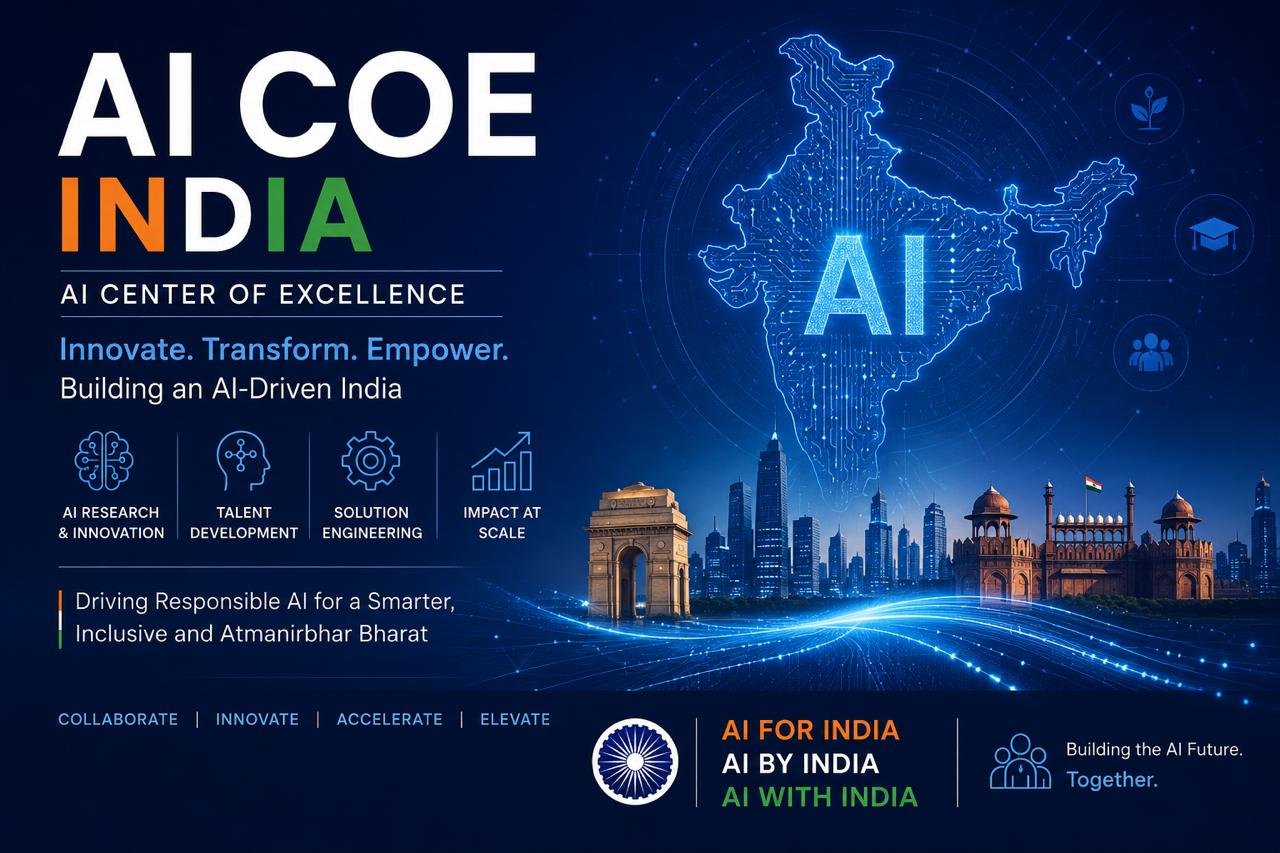
India's artificial intelligence landscape is undergoing a transformative shift. With the AI market projected to reach $8 billion by 2025 and growing at a 40% CAGR, the establishment of AI Centers of Excellence (CoEs) across the country is playing a pivotal role in accelerating innovation, skilling, and responsible AI adoption. As PM Modi stated at the India AI Impact Summit 2026, "AI stands at a civilisational inflection point" — and India is positioning itself at the center of this revolution.
This blog explores the key AI CoE initiatives, the massive infrastructure investments, workforce transformation, real-world impact, and the strategic roadmap shaping India's AI future.
1. The Vision Behind India's AI CoEs
An AI Center of Excellence (CoE) is a centralized team or institution that owns AI strategy, talent development, infrastructure, and governance for an organization or ecosystem. In India, AI CoEs are being established by the government, private sector, and academic institutions to:
- Accelerate AI research and development across priority sectors
- Bridge the AI talent gap (currently only 30% of India's tech workforce has AI skills)
- Drive sector-specific AI innovation in healthcare, agriculture, education, and governance
- Ensure responsible and ethical AI deployment through frameworks and standards
- Position India as a global AI leader (currently ranked 10th globally for private sector AI investments)
- Democratize access to AI compute, data, and tools for startups, researchers, and MSMEs
The Government of India has placed an inclusion policy at the heart of its AI strategy. National initiatives such as the IndiaAI Mission and the Centres of Excellence for AI are designed to ensure that AI remains open, affordable, and accessible to everyone.
2. The IndiaAI Mission: India's $1.1 Billion AI Backbone
Overview
The IndiaAI Mission was approved on 7 March 2024 by the Union Cabinet, with a massive budget outlay of ?10,371.92 crore (US$1.1 billion) over five years. It is implemented by the IndiaAI Independent Business Division (IBD) under Digital India Corporation (DIC).
Seven Core Pillars and Fund Allocation (2024-2029)
|
Pillar |
Fund Allocation |
|---|---|
| IndiaAI Compute | Rs.4,563.36 crore ($480M) |
| IndiaAI Datasets Platform (AIKosha) | Rs.99.55 crore ($21M) |
| IndiaAI Application Development Initiatives | Rs.689.05 crore ($73M) |
| IndiaAI FutureSkills | Rs.882.94 crore ($93M) |
| IndiaAI Innovation Center | Rs.1,971.37 crore ($210M) |
| IndiaAI Startup Financing | Rs.1,942.5 crore ($210M) |
| Safe & Trusted AI | Rs.20.46 crore ($2.2M) |
Key Achievements (as of 2026)
- 38,000+ GPUs onboarded for shared compute access
- 12 indigenous foundation models under development
- 30+ India-specific AI applications approved
- Sarvam AI selected to develop India's first sovereign LLM with reasoning, voice, and Indian language fluency
- Government supporting Indian researchers in designing indigenous GPUs
IndiaAI Compute Portal
The portal provides access to Nvidia H100, H200, A100, L40S, L4, AMD MI300x, MI325X, Intel Gaudi 2, AWS Trainium, and Inferentia GPUs. Computing costs are subsidized at:
- Less expensive GPUs: Rs.115.85/hour
- More expensive GPUs: Rs.150/hour
- 40% government subsidy applied
Approved providers include: Orient Technologies, CMS Computers, SHI Locuz, CtrlS, NxtGen Cloud Technologies, Yotta Infrastructure, Jio Platforms, Tata Communications, E2E Networks, and Vensysco Technologies.
AIKosha: IndiaAI Datasets Platform
A centralized platform offering:
- 80+ AI models and 300+ datasets
- AI sandbox capabilities with integrated development environment
- Permission-based access with security features (firewalls, encryption, secure APIs)
- Census data, geospatial data, and linguistic data collections
AIRAWAT Supercomputer
- Peak performance: 13,170 teraflops
- India's largest and fastest AI supercomputing machine
- Deployed at C-DAC, Pune (maintained by Netweb Technologies)
- Plan to expand to 1,000 AI Petaflops of Mixed Precision computing capacity
3. Government-Led AI Centers of Excellence
3.1 Three National AI CoEs (?990 Crore Investment)
In October 2024, Union Education Minister Dharmendra Pradhan announced the creation of three AI Centres of Excellence focused on:
Healthcare CoE:
- Leveraging AI for diagnostics, drug discovery, and public health
- AI tools enabling frontline workers to screen for TB and diabetic retinopathy
- Supporting 282 million telemedicine consultations nationwide
- Delivered a 27% reduction in adverse TB outcomes and 12–16% increase in case detection
Agriculture CoE:
- Using AI to improve crop yields, pest detection, and supply chain optimization
- AI-based pilot for local monsoon onset forecasting for Kharif 2025 reached 3.88 crore farmers across 13 states via SMS
- 31–52% of surveyed farmers adjusted sowing and land preparation decisions based on AI forecasts
- AI helping small farmers save significantly on pesticide consumption
Sustainable Cities CoE:
- Applying AI for smart urban planning, traffic management, and energy efficiency
- Integration with Smart Cities Mission for intelligent infrastructure
These CoEs have a budget of ?990 crore over five years and aim to enhance India's global standing in AI research and innovation.
3.2 AI CoEs for Public Health
The Ministry of Health has designated three premier institutions as Centers of Excellence for AI in healthcare:
- AIIMS Delhi – Lead institution for AI in medical diagnostics
- PGIMER Chandigarh – Focus on AI-driven clinical research
- AIIMS Rishikesh – Specializing in AI for rural healthcare delivery
The AIIMS CoE has collaborated with Wadhwani AI on the "Make AI in India" vision, scaling AI solutions for public health challenges.
India AI Impact Summit 2026 Highlights:
- Launched the AI Impact Casebook on Health with 24 real-world applications
- Six sectoral AI Impact Casebooks showcasing 170+ deployed and scalable AI innovations across Health, Energy, Gender Empowerment, Education, Agriculture, and Accessibility
3.3 AI Centre of Excellence in Education (Rs.500 Crore)
In the Union Budget 2025-26, Finance Minister Nirmala Sitharaman allocated ?500 crore for a Centre of Excellence in AI for Education, signaling that AI had become a workforce and productivity priority, not merely an IT ministry project.
Key focus areas:
- Personalized AI-driven education tools
- AI-powered reading and math score improvement in remote government schools
- Integration with iGOT-AI Mission Karmayogi for public officials' AI-driven learning
3.4 Delhi's Two AI Centres of Excellence (April 2026)
The Delhi government announced plans to set up two AI Centres of Excellence focused on:
- Governance innovation – Using AI to improve citizen services
- Economic growth – Nurturing cutting-edge research and startups
3.5 India AI Impact Summit 2026 – New Delhi
India hosted the Global South's first international AI summit in New Delhi (February 16-20, 2026), bringing together global leaders, policymakers, technology firms, innovators, and experts. Key outcomes:
- Launch of six sectoral AI Impact Casebooks
- Showcase of 170+ deployed AI innovations
- Global collaboration frameworks established
4. Private Sector AI CoE Initiatives
4.1 Cisco's AI and Networking CoE – Mumbai
Cisco launched a Centre of Excellence for AI, Networking, and Entrepreneurship in Mumbai in partnership with the Confederation of Indian Industry (CII). Located at the Multi Skill Training Institute in Kandivali, this CoE:
- Offers advanced courses in AI, networking, and cybersecurity
- Features hybrid classrooms, an innovation zone, and a makerspace
- Is part of Cisco's broader plan to train over 2.8 million people across India over three years
- Mumbai named the first international community in Cisco's 40 Communities initiative
4.2 TCS and Cisco AI-Focused CoE – Hyderabad
TCS and Cisco launched an AI-focused Center of Excellence at the TCS facility in Hyderabad (February 2026). This CoE focuses on:
- Enabling zero-touch operations
- Reducing complexities in IT operations
- Delivering business outcomes through AI-driven automation
- Eliminating friction in existing IT environments
4.3 TCS and OpenAI Partnership
At the India AI Impact Summit 2026, TCS signed up OpenAI as the anchor client for its upcoming data centre. The collaboration will:
- Develop secure, India-based AI infrastructure
- Strengthen data sovereignty
- Build long-term compute capacity
4.4 Infosys and Anthropic Partnership
Infosys partnered with Anthropic (ChatGPT maker's rival) to drive AI adoption across enterprises, focusing on responsible AI deployment and enterprise-grade solutions.
4.5 Reliance Jio's Massive AI Infrastructure
- $110 billion AI push announced by Reliance
- Partnership with Nvidia for 2,000MW of AI data centers
- $11 billion joint venture for 1 GW of AI data capacity in Andhra Pradesh
- AI tools for translation and weather information for rural farmers
- AI applications and services for 450 million Jio customers
- Infrastructure available to scientists, developers, and startups across India
4.6 Adani Group
- Pledged $100 billion for AI data centers
- Construction underway in Jamnagar, Gujarat with 120+ MW capacity expected online by late 2026
4.7 India's Data Centre Boom
- Installed DC capacity climbed to 1.3 GW across key metro markets in 2025
- Projections indicate a potential five-fold increase to 5 GW by 2030
- India targeting $200 billion in AI infrastructure investment
4.8 AWS Generative AI Center of Excellence for Partners
AWS launched a Generative AI Center of Excellence to help partners keep pace with rapid advancements in generative AI. The CoE provides exclusive resources including playbooks, training, marketing assets, and tools to help partners build solutions using AWS generative AI services like Amazon Bedrock and Amazon Q.
4.9 IBM India's AI Skilling Initiative
- Promised to skill 5 million people in India on AI, cybersecurity, and quantum computing by 2030
- Vision of building a 350 million AI-trained workforce that can be deployed globally
- Currently only ~30% of India's available technology workforce has the AI skills needed by businesses
5. AI Talent and Workforce Transformation
The Current Landscape (2026)
India's AI workforce is undergoing a fundamental transformation:
- 14% of job postings in India explicitly reference AI (up from 8.9% a year earlier)
- 86% of employers have seen AI impact job roles and responsibilities
- 35% report significant redefinition or transformation of roles
- 40% of employers expect a major workforce strategy rejig centered around AI
- 103% increase in internship postings, highlighting focus on hands-on AI training
- BFSI and telecommunications emerging as leaders in AI hiring shift
Skills Over Degrees
A joint Nasscom-Indeed report (May 2026) reveals:
- 40% of employers prefer demonstrable AI skills or certifications over degrees
- 32% give equal weight to skills, certifications, and degrees
- AI hiring is no longer concentrated within software engineering alone
- Top job categories: AI engineering, AI operations and infrastructure, data systems
India's AI Talent Pool Projections
- Current AI talent pool growing rapidly
- Projected to reach 1.25 million by 2027 (NASSCOM-Deloitte)
- IBM's vision: Transform 200 million workers into 350 million AI-trained workforce
- Global firms rethinking GCC (Global Capability Center) hiring in India as AI shifts skill demand
Key Skilling Initiatives
- IndiaAI FutureSkills (Rs.882.94 crore allocation)
- iGOT-AI Mission Karmayogi – AI-driven learning for public officials
- IndiaAI Startups Global Acceleration Program with Station F and HEC Paris
- AI Competency Framework for Public Sector Officials
- Cisco's plan to train 2.8 million people
- IBM's commitment to skill 5 million people by 2030
6. India's AI Ecosystem: The Bigger Picture
Startups Driving Innovation
|
Company |
Headquarters |
AI Focus |
Founded |
|---|---|---|---|
| Sarvam AI | Bengaluru | Generative AI, LLMs, Sovereign LLM | 2023 |
| Fractal Analytics | Mumbai/NYC | Data Analytics | 2000 |
| Haptik | Mumbai | Chatbot, Intelligence Assistant | 2013 |
| Yellow.ai | Bangalore/San Mateo | Enterprise Agentic AI | 2016 |
| Ola Krutrim | Bangalore | Agentic AI, Chatbots | 2023 |
| KissanAI | Surat | Agriculture AI | 2023 |
| Uniphore | Chennai/Palo Alto | Conversational Automation | 2008 |
| CoRover.ai | Bengaluru | Conversational AI | - |
| NxtGen Cloud | Bengaluru | Sovereign Cloud, Agentic AI | 2012 |
| AAGYAVISION | Bengaluru | Custom AI chips, Radar | 2022 |
Government Policies and Frameworks
- NITI Aayog's National Strategy for AI (2018) – #AIForAll
- Digital India – Fostering technological trust through digital public infrastructure
- Digital Personal Data Protection Act (2023) – Addressing privacy concerns
- Principles for Responsible AI (2021) – Ethical AI deployment guidelines
- Bureau of Indian Standards (BIS) – Drafting AI safety, reliability, and ethical standards
- India AI Mission (2024) – $1.1 billion comprehensive national initiative
International Collaborations
|
Partnership |
Focus Area |
Year |
|---|---|---|
| US-India AI Initiative | Bilateral R&D cooperation | 2021 |
| India-Japan AI Cooperation | ML, Deep Learning, Data Mining | 2018/2025 |
| India-France AI Roadmap | Safe, open, secure AI | 2025 |
| India-EU Trade & Technology Council | LLMs, Responsible AI | 2025 |
| Defense AI Dialogue (US-India) | Military AI applications | 2022 |
| US-India Critical & Emerging Tech | AI & Quantum ($2M+ funding) | 2024 |
| Telangana-Japan (TGDeX) | AI-ready datasets platform | 2025 |
| Honda-IIT Delhi/Bombay | Autonomous driving AI | 2024 |
| IndiaAI-Station F (Paris) | Startup acceleration | 2025 |
Market Projections
- $8 billion – India's AI market by 2025 (40% CAGR)
- $17 billion – India's AI services market by 2027 (NASSCOM-BCG)
- $200 billion – Targeted AI infrastructure investment
- 10th globally – India's rank for private sector AI investments
- India has the largest share of ChatGPT's mobile app users globally
- Third-largest user base for DeepSeek in 2025
7. Real-World Impact: AI CoEs Delivering Results
Healthcare
- 27% reduction in adverse TB outcomes through AI screening
- 12–16% increase in TB case detection
- 282 million telemedicine consultations supported by AI tools
- Frontline workers screening for TB and diabetic retinopathy using AI
- 24 real-world AI health applications showcased at India AI Impact Summit 2026
Agriculture
- AI monsoon forecasting reached 3.88 crore farmers across 13 states
- 31–52% of farmers adjusted decisions based on AI forecasts
- Significant savings on pesticide consumption for small farmers
- AI-driven crop yield optimization and pest detection
Education
- AI improving reading and math scores in remote government schools
- Personalized learning pathways for diverse student populations
- AI-driven learning recommendations for public officials (iGOT-AI)
Governance
- AI applications for citizen service delivery
- Smart city management and urban planning
- Digital public infrastructure enabling bottom-up AI adoption
8. AI Infrastructure: Building the Foundation
Compute Infrastructure
- AIRAWAT supercomputer at C-DAC Pune (13,170 teraflops peak)
- 38,000+ GPUs onboarded under IndiaAI Mission
- GPU types: Nvidia H100, H200, A100, L40S, L4; AMD MI300x, MI325X; Intel Gaudi 2; AWS Trainium & Inferentia
- Plan to expand AIRAWAT to 1,000 AI Petaflops
Data Center Investments
- India's DC capacity: 1.3 GW (2025), projected 5 GW by 2030
- Reliance Jio: 2,000MW AI data centers with Nvidia
- Adani: $100 billion pledge, 120+ MW in Gujarat
- TCS: Data centre with OpenAI as anchor client
- Total targeted investment: $200 billion
Sovereign AI Infrastructure
- India's first sovereign LLM by Sarvam AI
- Indigenous GPU design support from government
- Data sovereignty focus through India-based AI infrastructure
- AIKosha platform for secure, consent-based datasets
9. How to Build an Effective AI CoE: A Practical Framework
For organizations looking to establish their own AI Center of Excellence, here is a comprehensive framework:
Phase 1: Foundation (Months 1-3)
- Define Strategic Vision – Align AI objectives with business goals and national priorities
- Secure Executive Sponsorship – Ensure C-suite buy-in with clear ROI projections
- Assess Current State – Audit existing AI capabilities, data assets, and talent
- Establish Governance – Create AI ethics board and responsible AI guidelines
Phase 2: Build (Months 3-9)
- Assemble Cross-Functional Team – Data scientists, ML engineers, domain experts, ethicists, and business leaders
- Define KPIs – Measure success through:
- Number of AI models in production
- Time-to-deployment for AI solutions
- Business impact (revenue, cost savings, efficiency gains)
- AI adoption rate across business units
- Build Infrastructure – Leverage IndiaAI Compute Portal, cloud platforms (AWS, Azure, GCP)
- Develop Data Strategy – Establish data pipelines, quality frameworks, and governance
Phase 3: Scale (Months 9-18)
- Launch Pilot Projects – Start with high-impact, low-risk use cases
- Invest in Talent Development – Continuous upskilling through:
- IndiaAI FutureSkills programs
- Industry certifications (AWS, Google, Microsoft)
- Academic partnerships with IITs, IISc, IIITs
- Maintain External Partnerships – Collaborate with:
- Technology vendors (AWS, Nvidia, Google, Microsoft)
- Academic institutions
- Industry consortia (NASSCOM, CII)
- Government programs (IndiaAI Mission)
- Develop Communication Plan – Share initiatives and successes across the organization
Phase 4: Optimize (Ongoing)
- Ensure Responsible AI Governance – Address data privacy, ethics, bias, and transparency
- Measure and Iterate – Continuous improvement based on KPIs and feedback
- Scale Successful Models – Expand proven AI solutions across business units and geographies
- Contribute to Ecosystem – Share learnings, open-source tools, and participate in national AI initiatives
10. Regulatory Landscape and Responsible AI
Current Framework
India currently does not have specific laws regulating AI. However, the government has introduced several initiatives:
- NITI Aayog's Principles for Responsible AI (2021) – Covering decision-making, accountability, and societal impact
- Digital Personal Data Protection Act (2023) – Addressing privacy concerns related to AI
- MeitY Advisories – Requiring explicit permission before deploying unreliable AI models and labeling AI-generated content
- Bureau of Indian Standards (BIS) – Proposing draft standards for AI safety, reliability, and ethics
- Global Partnership on AI (GPAI) – India as active member promoting responsible AI
Key Principles
- Transparency and explainability in AI decision-making
- Accountability for AI outcomes
- Fairness and non-discrimination
- Privacy and data protection
- Safety and security
- Human oversight and control
11. Key Challenges and the Road Ahead
While AI CoEs present significant opportunities, India must address:
Talent Gap
- Only 30% of India's tech workforce currently has AI skills needed by businesses
- Need to transform 200 million workers into 350 million AI-trained workforce
- 86% of employers seeing AI impact job roles, requiring massive reskilling
Data Challenges
- Data privacy concerns – Balancing innovation with citizen data protection
- Need for high-quality, India-specific datasets in local languages
- Data sovereignty requirements for sensitive sectors
Infrastructure
- Building robust compute and data infrastructure across tier-2 and tier-3 cities
- Bridging the digital divide for equitable AI access
- Energy requirements for massive AI data centers
Ethical and Safety Concerns
- Ensuring fairness, transparency, and accountability in AI systems
- Combating AI-powered cyberattacks targeting organizations
- Preventing misuse of deepfakes and AI-generated content
- Addressing job displacement concerns
Research and Innovation
- Concentration of AI talent and capital in few firms globally
- Need for more indigenous AI research and patents
- Bridging gap between academic research and commercial deployment
12. The Road to 2030: India's AI Ambitions
Near-Term Goals (2026-2027)
- Complete deployment of 38,000+ GPUs under IndiaAI Compute
- Launch 12 indigenous foundation models
- Deploy 30+ India-specific AI applications at scale
- Train 1.25 million AI professionals
Medium-Term Goals (2027-2029)
- Achieve $17 billion AI services market
- Expand AIRAWAT to 1,000 AI Petaflops
- Scale AI CoEs across all states
- Establish India as top-5 global AI research hub
Long-Term Vision (2030+)
- $200 billion AI infrastructure ecosystem
- 350 million AI-trained workforce
- 5 GW data center capacity
- AI-driven governance across all government services
- India as global AI talent and innovation hub
Conclusion
India's AI Centers of Excellence represent a strategic national investment in the future. From the Rs.10,371.92 crore IndiaAI Mission to government-backed CoEs in healthcare, agriculture, and education, from private sector mega-investments by Reliance ($110B), Adani ($100B), TCS-OpenAI, and Infosys-Anthropic partnerships, to the massive workforce transformation underway — India is building one of the world's most comprehensive AI ecosystems.
The numbers tell the story: 38,000+ GPUs deployed, 170+ AI innovations showcased, 3.88 crore farmers reached by AI forecasting, 282 million telemedicine consultations supported, and a vision to create a 350-million-strong AI-trained workforce.
The journey from "using AI" to "running on AI" has begun — and India's Centers of Excellence are leading the charge. As India hosted the Global South's first international AI summit in 2026, the message is clear: AI is no longer just a technology initiative — it's a civilizational priority.
Sources: Press Information Bureau (PIB), IndiaAI.gov.in, India AI Impact Summit 2026, Times of India, Economic Times, Forbes, Reuters, CNBC, Indian Express, NASSCOM-Indeed Report 2026, Carnegie Endowment, Cisco News, AWS Partner Network
Last Updated: May 2026