




Introduction: The Complexity Crisis in Cloud Operations
The cloud revolution has transformed how organizations build, deploy, and manage applications. But with this transformation comes an exponential increase in complexity. Modern cloud environments generate petabytes of telemetry data — metrics, logs, traces, and events — that no human team can analyze manually. As organizations adopt microservices architectures, containers, multi-cloud strategies, and cloud-native technologies, the volume of alerts and events has grown dramatically, making it nearly impossible for operations teams to discern whether customers are impacted.
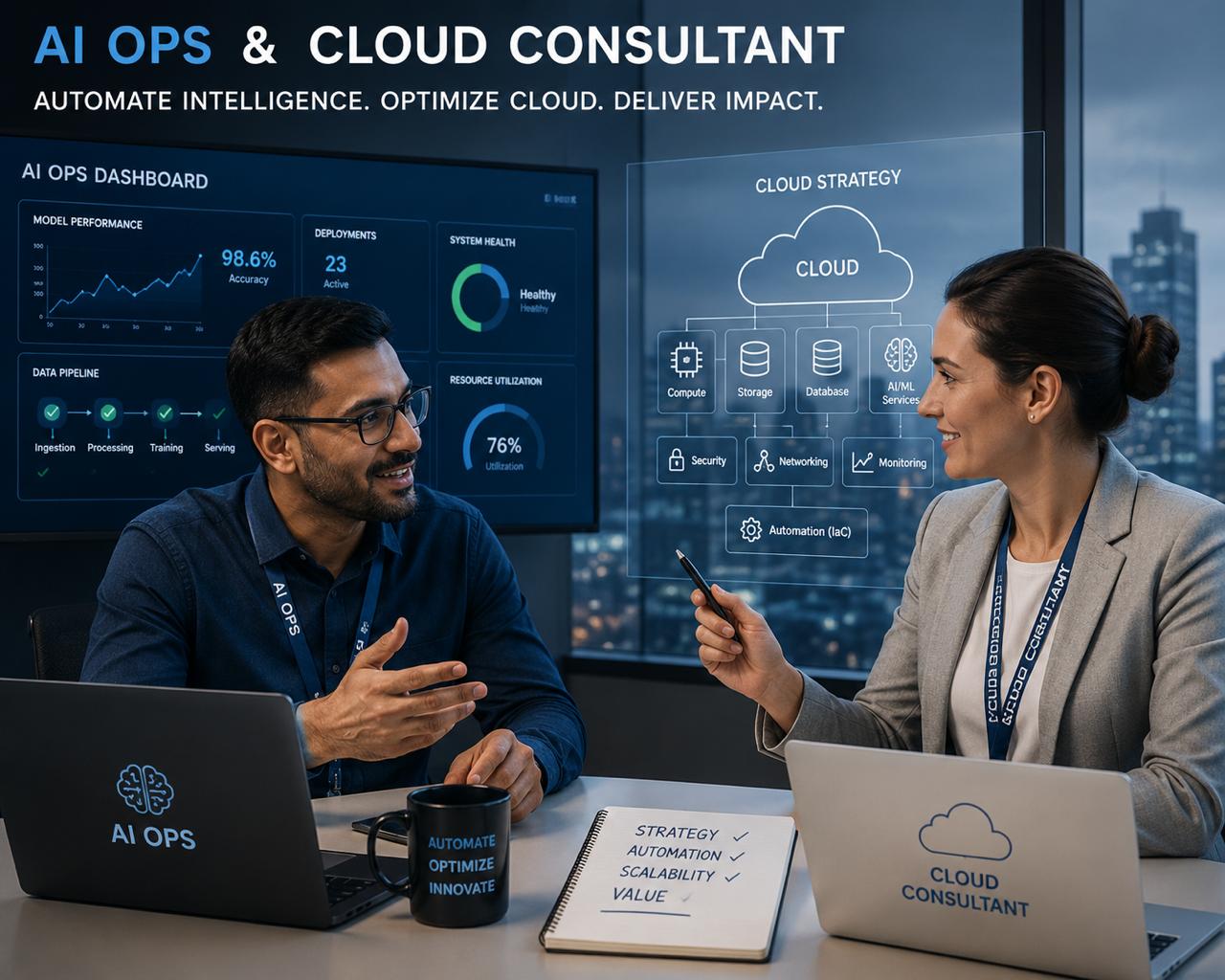
AIOps (Artificial Intelligence for IT Operations) is the application of AI technologies — such as machine learning (ML) and natural language processing (NLP) — to automate and enhance IT operations. It enables IT teams and DevOps engineers to detect incidents faster, streamline root cause analysis, and optimize system performance. AIOps applies machine learning to full-stack telemetry to surface real signals, detect issues earlier, and correlate alerts into enriched incidents, reducing manual triage and speeding up resolution
This blog explores why AIOps has become indispensable for three critical cloud roles: Cloud Engineers, Cloud Architects, and DevOps Professionals.
The Problem: Why Traditional Operations Fall Short
Before diving into role-specific benefits, let's understand the challenges that make AIOps necessary:
-Data Overload: Amazon processes 17 exabytes of CloudWatch logs monthly. Human teams cannot keep up with analyzing this volume of raw observability data.
- Alert Fatigue: Cloud environments generate thousands of alerts daily. Without intelligent correlation, teams waste time on false positives and miss critical issues.
- Complex Dependencies: Microservices, APIs, and distributed systems create intricate dependency chains that are impossible to trace manually.
- Speed Requirements: Modern SLAs demand sub-minute detection and rapid resolution. Manual triage simply cannot meet these expectations.
- Skill Gaps: The technology industry has created an artificial barrier around operations, leaving infrastructure engineers feeling excluded from transformative AI-driven movements.
Why Cloud Engineers Need AIOps
Cloud Engineers are responsible for building, maintaining, and troubleshooting cloud infrastructure. AIOps transforms their daily operations in several critical ways:
1. Intelligent Monitoring & Anomaly Detection
AIOps provides real-time assessment and predictive capabilities to quickly detect data deviations and accelerate corrective actions. Cloud Engineers no longer need to rely solely on static threshold-based alerts. Instead, ML algorithms continuously analyze metrics, determine normal baselines, and surface anomalies with minimal user intervention.
Practical Example: Using Amazon CloudWatch Anomaly Detection, Cloud Engineers can apply statistical and machine learning algorithms that continuously analyze system metrics, automatically identifying when behavior deviates from established patterns — without manually setting thresholds for every metric.
2. Automated Remediation
AIOps enables Cloud Engineers to build self-healing systems. When an anomaly is detected, automated workflows can trigger remediation actions — scaling resources, restarting services, or isolating compromised instances — without waiting for human intervention.
3. Capacity Planning & Optimization
AIOps solutions support cloud transformation by providing transparency, observability, and automation for workloads. Cloud Engineers can use AIOps monitoring tools to compute cloud usage and increase capacities to support traffic growth proactively rather than reactively.
4. Reduced Mean Time to Resolution (MTTR)
CloudWatch Investigations, an AI-powered tool, automatically surfaces relevant metrics, logs, and traces to reduce incident resolution time by 80%. It eliminates the need for Cloud Engineers to manually navigate between different monitoring tools during critical outages.
Why Cloud Architects Need AIOps
Cloud Architects design the blueprints for enterprise cloud environments. AIOps fundamentally changes how they approach architecture design and governance:
1. Designing for Observability at Scale
Modern architectures must be designed with AIOps in mind. Cloud Architects need to ensure that systems produce the right telemetry data — metrics, logs, and traces — that ML algorithms can consume. AIOps provides a unified approach to managing public, private, or hybrid cloud infrastructures, improving observability so IT teams can seamlessly manage data across different storage, networks, and applications.
2. Predictive Architecture Decisions
With AIOps, Cloud Architects can anticipate and mitigate future issues by analyzing historical data with ML technologies. ML models analyze large volumes of data and detect patterns that escape human assessments. This enables architects to make data-driven decisions about scaling, redundancy, and failover strategies before problems occur.
3. Multi-Cloud & Hybrid Complexity Management
As organizations move toward multi-cloud strategies, the complexity of managing interdependencies grows exponentially. AIOps is the intelligent engine that supercharges the operational toolchain, providing the advanced analytics and automation needed to manage the complexity that modern cloud architectures create. Cloud Architects can design systems knowing that AIOps will handle the operational complexity their designs introduce.
4. Cost Optimization Through Intelligence
AIOps allows organizations to derive actionable insights from big data while maintaining a lean team of data experts. Cloud Architects can design cost-efficient architectures knowing that AIOps will continuously optimize resource utilization, identify waste, and recommend right-sizing opportunities.
5. Security Architecture Enhancement
AIOps enhances security posture by detecting anomalous patterns that may indicate breaches, unauthorized access, or data exfiltration. Cloud Architects can integrate AIOps into their security architecture to provide continuous, intelligent threat detection that goes beyond rule-based systems.
Why DevOps Professionals Need AIOps
DevOps bridges development and operations. AIOps is the natural evolution that brings AI-driven intelligence to DevOps workflows:
1. Accelerated CI/CD Pipelines
DevOps teams use AIOps tools to improve code quality. They can automate code review, apply programming best practices, and detect bugs earlier in the development stages. Rather than delegating quality checks to the end of the development cycle, AIOps tools shift quality checks to the left.
2. Intelligent Incident Management
AIOps correlates alerts into a single, enriched incident, reducing manual triage and speeding up root cause analysis for developers on call. Instead of wading through hundreds of disconnected alerts, DevOps engineers receive correlated, contextualized incidents with probable root causes already identified.
AWS Implementation: Amazon DevOps Guru, integrated with AWS Systems Manager Incident Manager, automates the creation of incidents and response plans, OpsCenter OpsItems for insights and violations, providing a complete AIOps solution for microservices.
3. Noise Reduction & Signal Clarity
AIOps enhances DevOps and SRE workflows by applying machine learning and automation to noisy, distributed infrastructure. It helps correlate alerts, identify root causes, and reduce false positives across cloud-native environments. ML algorithms separate noise from data sources, so DevOps engineers can focus on important events rather than drowning in alert storms.
4. DevAIOps: The Convergence
As AI and cloud technologies become pervasive, organizations are moving toward AI-native teams aligned with DevAIOps — bringing DevOps practices together with AI-driven workflows. Industry research underscores why this transformation is imperative for staying competitive.
5. Continuous Compliance & Governance
AIOps enables DevOps teams to maintain continuous compliance by automatically detecting configuration drift, security violations, and policy breaches. Automated remediation workflows can restore compliance without manual intervention, ensuring that the speed of DevOps doesn't compromise governance.
AIOps in Action: Real-World Use Cases
Use Case 1: Proactive Incident Prevention
AIOps can predict incidents before they happen by analyzing patterns in historical data. Rather than reacting to outages, teams use predictive analytics and real-time data processing to reduce disruptions to critical services.
Use Case 2: Root Cause Analysis at Machine Speed
AI/ML technologies rapidly process big data and correlate between multiple probable causes. Organizations can investigate beyond symptoms or alerts to the true causes impacting system performance.
Use Case 3: Application Performance Monitoring
Modern applications use complex software technologies to run and scale across the cloud environment. It's challenging to gather metrics with traditional methods from modern scenarios — like data exchanges between microservices, APIs, and data storages. AIOps gathers and compiles relevant metrics at scale.
Use Case 4: Conversational AIOps
Next-generation AIOps integrates with conversational AI. For example, Amazon CloudWatch Investigations integrated with Amazon Nova Sonic enables operations teams to detect, analyze, and resolve issues through natural voice conversation, transforming incident management from complex technical procedures into an intuitive dialogue experience.
The Three Phases of AIOps Implementation
Phase 1: Observe
Intelligent collection of data from your IT environment. AIOps improves observability amongst disparate devices and data sources. By deploying big data analytics and ML technologies, you can ingest, aggregate, and analyze massive amounts of information in real time.
Phase 2: Engage
Operations teams reduce their dependencies on conventional IT metrics and alerts. They use AIOps analytics to coordinate IT workloads on multi-cloud environments. IT and operational teams share information with a common dashboard to streamline efforts in diagnosis and assessment
Phase 3: Act
AIOps technologies take actions to improve and maintain IT infrastructure. IT teams create automated responses based on ML-generated analytics. They deploy intelligent systems that learn from historical events and preempt similar issues with automated scripts.
Key Benefits Summary
For Cloud Engineers:
- 80% reduction in incident resolution time with AI-powered investigations
- Automated anomaly detection eliminates manual threshold management
- Self-healing infrastructure reduces on-call burden
- Proactive capacity management prevents outages
For Cloud Architects:
- Data-driven architecture decisions based on predictive analytics
- Unified observability across multi-cloud environments
- Cost optimization through intelligent resource management
- Security architecture enhanced with ML-based threat detection
For DevOps Professionals:
- Shift-left quality with AI-powered code review
- Correlated incidents replace alert storms
- Continuous compliance without manual audits
- Faster release cycles with predictive failure detection
Getting Started: A Roadmap for Adoption
Step 1 — Foundation (Weeks 1-4)
- Enable CloudWatch across all workloads
- Activate CloudWatch Anomaly Detection for critical metrics
- Set up centralized logging and tracing
Step 2 — Intelligence (Weeks 5-8)
- Deploy Amazon DevOps Guru for application insights
- Configure CloudWatch Application Insights
- Implement automated incident creation with Systems Manager
Step 3 — Automation (Weeks 9-12)
- Build automated remediation runbooks
- Integrate AIOps insights with CI/CD pipelines
- Implement predictive scaling based on ML forecasts
Step 4 — Optimization (Ongoing)
- Continuously tune ML models with feedback loops
- Expand coverage to all environments (dev, staging, production)
- Implement conversational AIOps for faster incident response
Conclusion: The Imperative for Cloud Professionals
AIOps is not a luxury — it's a necessity for modern cloud professionals. As cloud environments grow in complexity, the gap between what humans can manage and what systems demand continues to widen. AIOps bridges this gap by applying machine learning and analytics to the flood of operational data, detecting anomalies, correlating events, predicting potential failures, and surfacing issues earlier in the lifecycle.
For Cloud Engineers, AIOps means faster detection, automated remediation, and freedom from alert fatigue. For Cloud Architects, it means designing intelligent, self-optimizing systems that scale gracefully. For DevOps Professionals, it means accelerated delivery, reduced MTTR, and continuous compliance.
The organizations that embrace AIOps today will be the ones that thrive in tomorrow's increasingly complex cloud landscape. The question is no longer *whether* to adopt AIOps, but how quickly you can integrate it into your cloud operations strategy.
Start your AIOps journey today with AWS services like Amazon DevOps Guru, CloudWatch Investigations, and Systems Manager Incident Manager.